
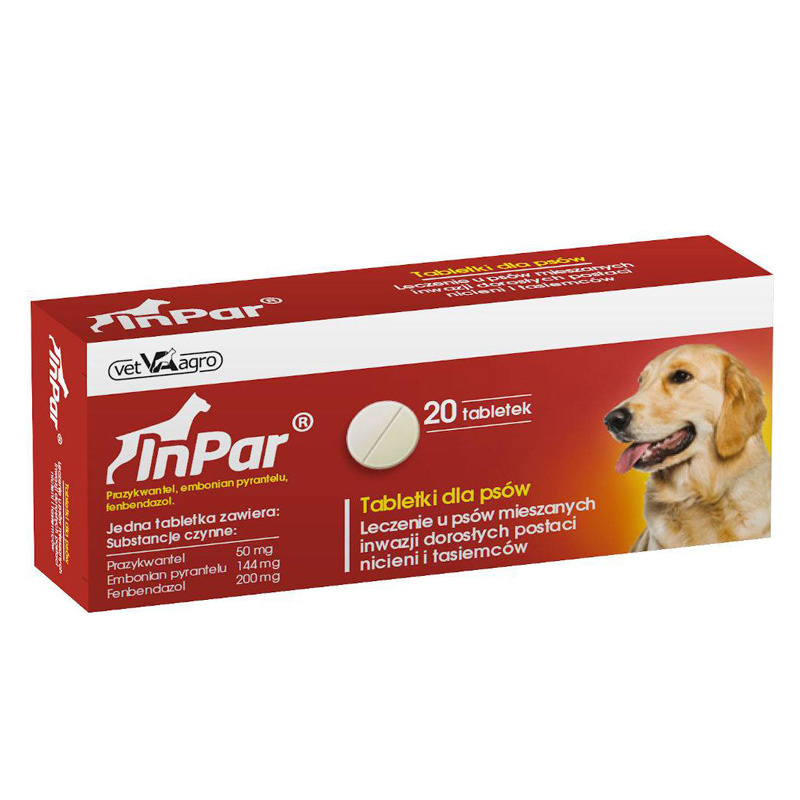
Inpar Deworming Tablets for Dogs, 20 tablets
Indications:
Treatment of mixed infestations in dogs with adult nematodes and tapeworms of the following species:
- Roundworms: Toxocara canis, Toxascaris leonina (adult and immature forms),
- Hookworms: Ancylostoma caninum, Uncinaria stenocephala (adult forms),
- Whipworms: Trichuris vulpis (adults),
- Tapeworms: Dipylidium caninum, Taenia hydatigena, Taenia pisiformis (adult and immature forms).
Dosage and Routes of Administration:
The tablet can be administered directly into the dog's mouth or crushed and mixed with food.There is no need to withhold food from the animal during treatment.
Recommended dose: 1 tablet per 10 kg of body weight.c.
For routine treatment, a single dose is sufficient.If an infestation is diagnosed, treatment should be repeated after 14 days.
To ensure that the correct dose is administered, body weight should be determined as accurately as possible.
Contraindications:
Do not use in case of hypersensitivity to the active ingredients or to any of the excipients.Do not use simultaneously with products containing piperazine derivatives and/or organic phosphate esters.
Special warnings:
Parasites may develop resistance to a group of antiparasitic products as a result of frequent, repeated use of products from that group.If the treatment is ineffective, consult a veterinarian, who may order laboratory tests and, based on the results, may recommend a product with a different mechanism of action.In the case of a confirmed, single infestation with only tapeworms or only nematodes, a single-ingredient product containing only a tapeworm-killing or nematode-killing agent should be used.Fleas are intermediate hosts and a source of infection for one of the most common tapeworms—Dipylidium caninum.Tapeworm infestations may recur if a program to control intermediate hosts—such as fleas and mice—as well as the environment is not implemented alongside treatment.
In rare cases, loss of appetite, diarrhea, vomiting, lethargy, or a temporary increase in AST (aspartate aminotransferase) levels may occur.
The frequency of adverse reactions is presented according to the following rule:
- very common (more than 1 in 10 treated animals experiencing an adverse effect);
- frequently (more than 1 but fewer than 10 out of every 100 treated animals);
- not very common (more than 1 but fewer than 10 per 1,000 treated animals);
- rare (more than 1 but fewer than 10 per 10,000 treated animals);
- very rare (fewer than 1 in 10,000 treated animals, including isolated reports).
Active ingredient:
Praziquantel 50 mg, Pyrantel embonate 144 mg, Fenbendazole 200 mg