What is an Oriental cat?? Character, appearance, and breed requirements
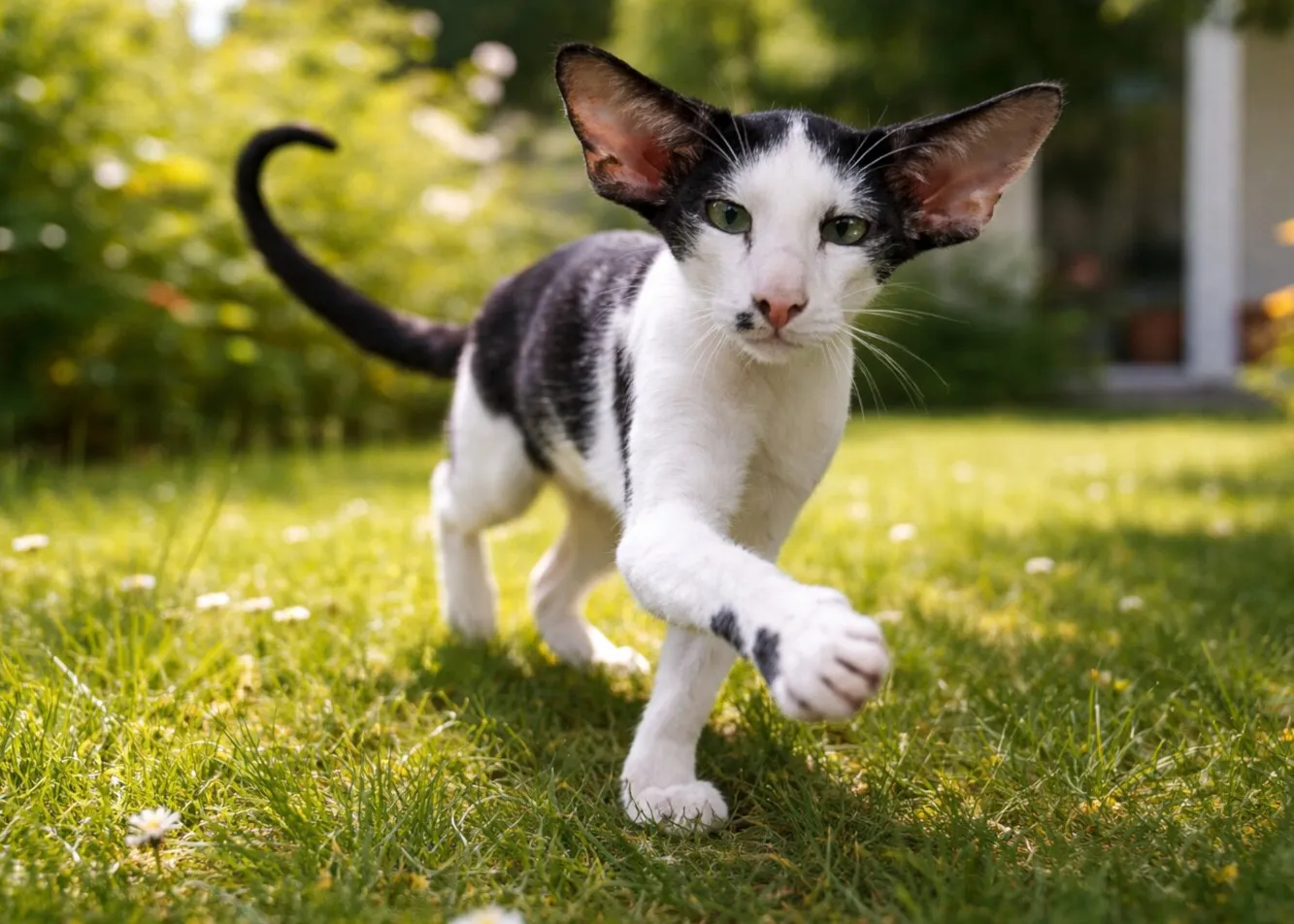
The Oriental cat is a breed created by humans, bred to have a specific appearance and temperament.Russian Blue, Abyssinian, and British Shorthair cats were used in its development, and they were then crossed with Siamese cats to reinforce the slender build and exceptionally expressive temperament.After World War II, the population of Oriental cats was so small that the breed was on the brink of extinction—fortunately, it was successfully revived.Today, it comes in two varieties: short-haired and long-haired.These are elegant, slender, "athletic" cats.They are also very sociable, lively, and people-oriented, which makes them devoted but also demanding family members.
Oriental Cat – Breed Description, Appearance, Temperament, Care, and Health
Country of origin: United Kingdom.
Body weight: approx..2.5 kg (females) – 4.5 kg (males).
Average lifespan: a long-lived breed – usually 15–20 years.
Physical characteristics: ears very large, broad at the base, set in a wedge-shaped line; eyes almond-shaped, slightly slanted, preferably intense green; head large and wedge-shaped; neck long and slender; body of medium size, elongated and supple, but not massive; shoulders and chest of similar width to the hips; legs long and slender; feet oval; tail long, thin at the base, flexible, tapering to a pointed tip.
Coat type: Oriental cats come in both short- and long-haired varieties (depending on their genes).In both cases, the hair lies flat against the body, is shiny, and feels silky to the touch.Although many individuals are solid-colored, the breed is known for its vast array of coat colors (sometimes as many as.(300 variations).In breeding, all colors are accepted, provided they do not include white or white markings.
Fun fact: Because of their curiosity about the world, their “talkativeness,” and their need to interact with people, Oriental cats are sometimes called “cat border collies”.
Origin and history – how this breed came to be?
The modern Oriental cat is a breed that has been artificially recreated and selectively bred.In breeding programs, m were crossed with.in.Russian Blue, Abyssinian, and British Shorthair cats, and their offspring were then crossed with Siamese cats.The goal was to achieve a specific, slender build and a temperament that is intelligent, energetic, and highly people-oriented.Initially, the different color varieties were treated as separate breeds, but over time they were grouped under the single name “Oriental cat,” with the only distinction being between the short-haired and long-haired varieties.
In 1970, British Oriental cats were brought to the United States, where further crossbreeding began—this time with.in.with American Shorthair cats.This further expanded the range of coat colors and patterns.At some point, however, it was decided to set aside the chocolate-colored cats and give them the name “Havana Brown,” creating a separate breed with Oriental roots.
The personality and temperament of the Oriental cat – who is it best suited for??
Oriental cats have inherited many traits from their Siamese ancestors.They are lively, energetic, and very intelligent—they love games, challenges, and activities that engage their minds.They are usually sociable, friendly, and adapt well to a busy household.These are also “talkative” cats: they can meow, call out, and even seem as if they’re having a conversation with their owner.So if you're looking for a quiet, low-maintenance cat, the Oriental breed is unlikely to meet those expectations.
Oriental cats can be stubborn and very determined when pursuing their goals.They are persistent, don’t give up easily, and know how to “negotiate” effectively—for example, when something interests them but the door to the room remains closed.Their strong personality may come as a surprise, as it stands in contrast to their slender, delicate figure.These are confident cats that are reluctant to back down, even when faced with a larger cat or dog.
They form stable relationships with people, usually without showing a clear preference for any one person in the household.They’re also quite tolerant of household noises and everyday activity, yet they adapt perfectly to any situation.Above all, however, they need attention—both emotional and physical.They enjoy being close to people and being petted; they often don’t mind being held, and frequently take sleeping with their owner for granted.If they are ignored for a long time, it can affect their well-being and behavior: the cat becomes frustrated, and in extreme cases may develop stress-related disorders.
Requirements and Care – How to Care for an Oriental Cat?
Oriental cats are very agile and nimble, thanks to their.in.strong hind legs.That’s why it’s important to design the space thoughtfully: tall scratching posts, shelves, stable pathways, and spots where they can observe their surroundings from above are great options for them.
Interestingly, these cats can “become attached” to objects.They often have favorite toys that they treat almost like treasures, so it’s a good idea to make sure they don’t end up lost under a cabinet or sofa—some cats can really get upset about that.Their intelligence and curiosity mean they'll explore every nook and cranny: closets, drawers, shelves.If your cat’s tendency to rummage through things is a problem, you may need to protect your furniture.
For the same reason, secure window and balcony locks are absolutely essential.The nets must be tight and sturdy—even a small hole or gap can be exploited by an agile, determined cat.
Caring for their fur isn't particularly difficult, though of course it's a good idea to brush them regularly—especially the long-haired variety.It’s also a good idea to use the right cat grooming products , which help keep their coat in good condition and make daily grooming easier.However, as with all pets, preventive veterinary care is very important: keeping up with vaccination schedules (even for indoor cats), deworming, and health checkups.
Diet is also important: wet cat food , high in meat, rich in high-quality animal protein, and omega-3 fatty acids.This diet promotes energy, fitness, as well as healthy skin and a shiny coat.

The Health of an Oriental Cat – What to Look For?
Oriental cats may be predisposed to congenital and hereditary diseases.The following are listed.in.:
− polycystic kidney disease (PKD),
− hypertrophic cardiomyopathy (HCM),
− dilated cardiomyopathy (DCM),
− progressive retinal atrophy (PRA),
− polydactyly (an abnormal number of fingers),
− squint,
− jaw deformities,
− gangliosidosis,
− mucopolysaccharidosis type VI,
− feline undulating skin syndrome,
− increased susceptibility to allergies,
− an increased risk of developing lymphoma.
Therefore, before purchasing a cat of this breed, it is essential to review the records not only of the kitten but also of its parents—especially regarding genetic disease screening and breeding practices (testing, preventive care, socialization)..
Remember!
A purebred cat is an animal with a multi-generational pedigree that comes from a legally operating cattery.When choosing a cattery, it is best to check whether it is affiliated with one of the federations under the World Cat Congress (WCC)—an organization that sets guidelines for animal welfare and standards of conduct, including the minimum age for releasing kittens to new homes (12 weeks).Otherwise, it’s easy to unwittingly support substandard breeding operations where animal welfare takes a back seat to profit motives.
Q&A – Frequently Asked Questions About This Breed
Is an Oriental cat a good choice for beginners??
Yes, but only if you know what you're getting yourself into.This is a very sociable, active breed that craves attention, so it’s a good fit for people who want a cat to share their life with, rather than a quiet loner.
Are Oriental cats loud??
That's often the case.This is one of the most "chatty" breeds—they can call out to their owner and demand attention.If you value quiet, this might not be the best choice.
Is this breed suitable for a home with children??
Usually, yes, as long as the youngest members of the household respect the cat’s boundaries and know how to handle the animal.Oriental cats are sociable and curious, but they don't like being pestered or constantly bothered.
Can an Oriental cat be left home alone for several hours??
Probably not.Prolonged loneliness can be difficult for them and may lead to stress and behavioral problems.If you're often away from home, consider getting a second cat with a similar temperament or a more independent breed.
Author: M.Biegańska-Hendryk
Recommended

Dolina Noteci Premium Wet Cat Food with Salmon Fillet, 12-pack (185 g each) + Free DNP Salmon Fillet (185 g)
Piper Animals Junior Wet Cat Food with Veal, 12-pack (185 g each)