
The sense of smell – a key attractant
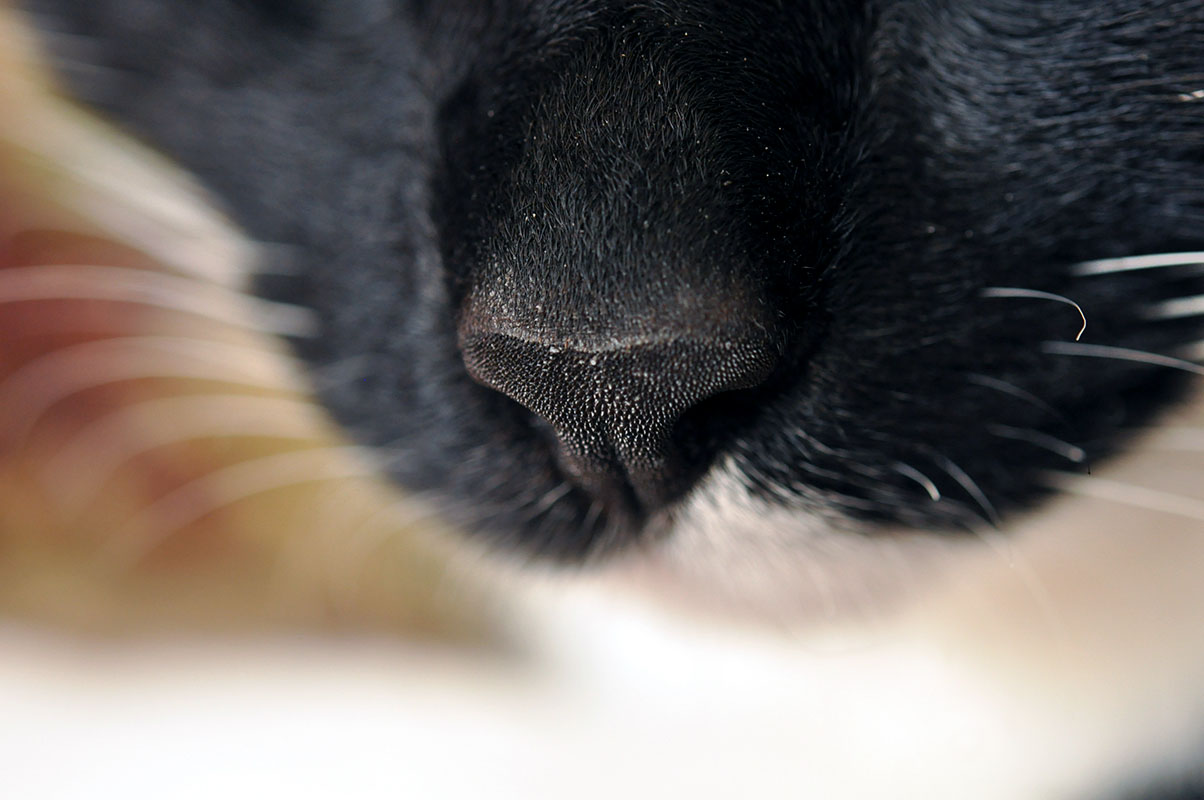

The sense of smell is of immense importance to our pets—when an animal loses it or when it is temporarily impaired (e.g., due to illness), we can compare it to a situation in which we would lose one of our most important senses, namely sight.To animals, the world is a vast catalog of scents.Although dogs remain the undisputed leaders in this field, cats are hot on their heels.
How sensitive is a cat's nose??
The sense of smell is the first to develop after birth and usually remains with a cat for the rest of its life.It is through their sense of smell that babies recognize their mothers, and the ability to detect her specific pheromones calms them and gives them a sense of security.
The human nose is equipped with about.20 million olfactory receptors, whereas a cat’s nose—which is, after all, much smaller—has about.100 million (a dog, on the other hand, has about.(280 million).As a result, your cat knows exactly which cabinet you hide its favorite treats in, what you’re using to make your sandwich, and exactly when you start putting food in its bowl—even if you try to do it silently.To put it simply, we can't compete with a cat's sense of smell, and the ability to perceive our surroundings in such rich detail is completely foreign to us.
Smell and taste – an essential combination
That's just the way it is: when you gain in one area, you usually lose in another.And that’s exactly how the relationship between a cat’s sense of smell and taste works.This second sense is very underdeveloped in our pets, and their interest in food depends primarily on its smell.For this reason, cats suffering from upper respiratory infections often refuse to eat at all—the loss of their sense of smell severely reduces their appetite.
So what can you do to get your cat interested in its meal??The simplest method is to gently heat it (to a temperature of about.(38°C).In this situation, the food begins to give off a stronger aroma, which may encourage our pet to eat it.
Unfortunately, it is a myth that cats, thanks to their excellent sense of smell, can sense when something is harmful to them and will refuse to eat it.If that were actually the case, instances of food poisoning in cats caused by eating spoiled food would be rare, but that is not the case.So let’s remember that we are primarily responsible for ensuring our cats’ meals are fresh, and a cat’s sense of smell isn’t always reliable in this regard.
The Importance of Smell in Communication
A cat's sense of smell isn't just a sense used for finding food.It is also a very important element in feline communication.
In the feline world, the language of scents is just as important as sounds, gestures, and body language.In their natural habitat, cats use two types of scent signals: pheromones and feces.The latter method, in particular, allows them to communicate over long distances—it’s like leaving “yellow sticky notes” in specific spots with a message that another animal will read when it happens to pass by.This form of communication reduces the risk of direct conflict and is particularly common in any "discussions" of a territorial nature.
Pheromones, on the other hand, are secreted by glands located on the cat's body: m.in.around the corners of the mouth, between the paw pads, and around the tail.Cats detect pheromone signals through the Jacobson's organ—a specialized organ located between the roof of the mouth and the nasal passages that allows cats to "taste" scents.To do this, the cat uses its tongue to force air into the organ, making a distinctive facial expression that results from the upper lip puckering.This behavior is known in the literature as the flehmen response.
Some researchers believe that cats remember the scents they analyze using their Jacobson's organ for the rest of their lives.Unfortunately, in some animals, pathological changes occur in the mucous membrane lining the organ—this is a result of inflammation.These cats lose their sensitivity to pheromones, which significantly impairs their olfactory communication.
Scents in the Home
Now that we know how sensitive and important a cat’s sense of smell is, it’s worth taking a closer look at some of the things we do and the decisions we make at home.First and foremost, remember that a cat's litter box must always be clean.Even a slight unpleasant odor coming from that area can cause a cat to stop using the litter box properly due to the discomfort it feels.
It’s also a good idea to avoid strongly scented cleaning products (especially those containing chlorine), as they can be irritating to cats.Many animals feel uncomfortable around artificial air fresheners, scented closet liners, or strong perfumes worn by their owners.Even when washing cat blankets or beds, it’s best to choose mild detergents with a subtle scent so that your cat doesn’t become averse to its resting spot after washing.For the same reason, many animals cannot tolerate scented litter or litter box fresheners.
In short, scent is a very delicate matter.Let’s keep this in mind as we care for our pets every day.