Puppy biting and aggression in dogs – why should you see a specialist?
Dogs, just like people, can vary in character and temperament.Some are very lively, while others are naturally calm.Much depends on the specific breed, the dog’s upbringing, its environment, and its life experiences, but also on genetic factors and its prenatal development.Sometimes, a cute little puppy starts to exhibit undesirable behavior over time.He bites, growls, and barks, which frustrates the rest of the family.
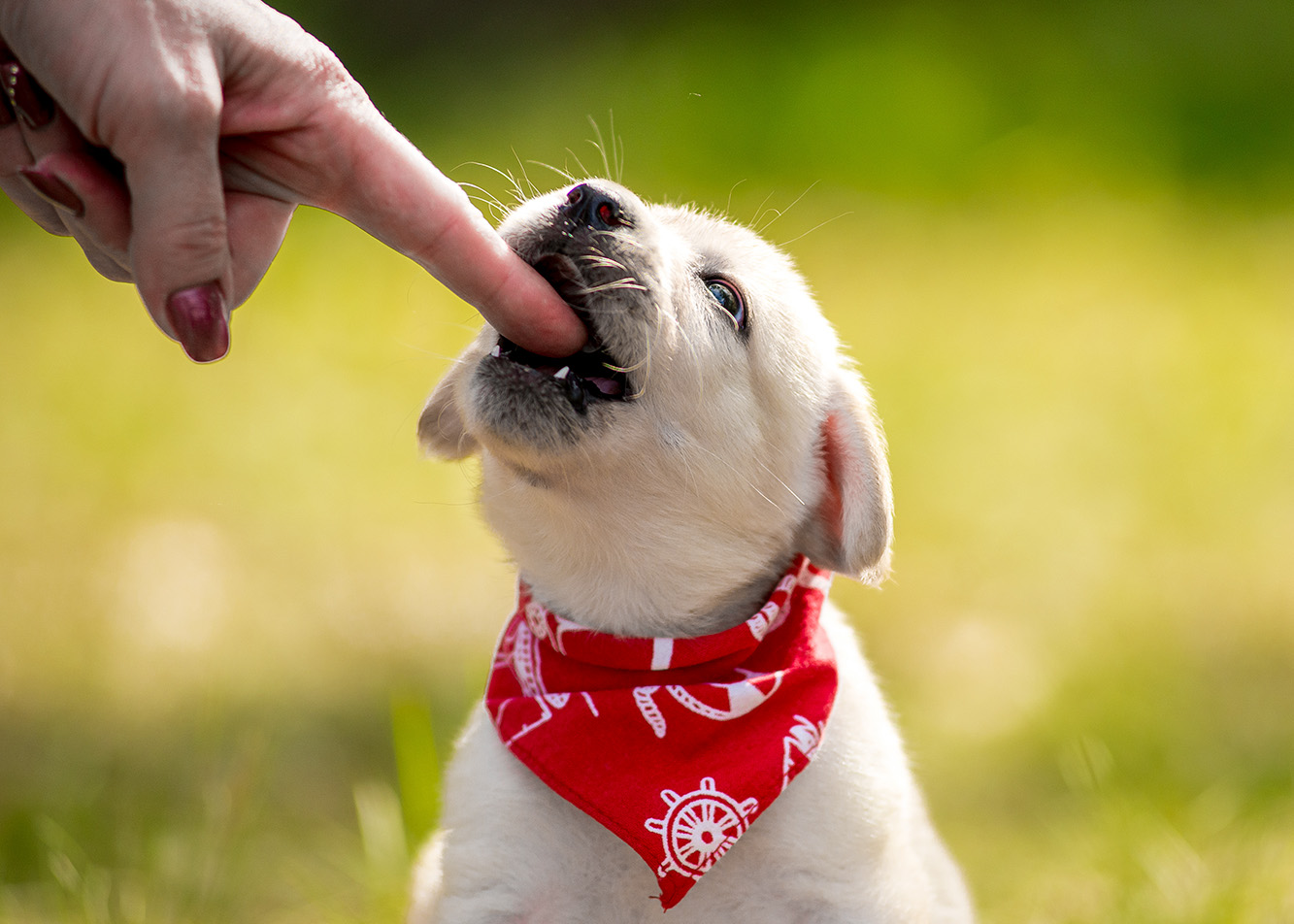
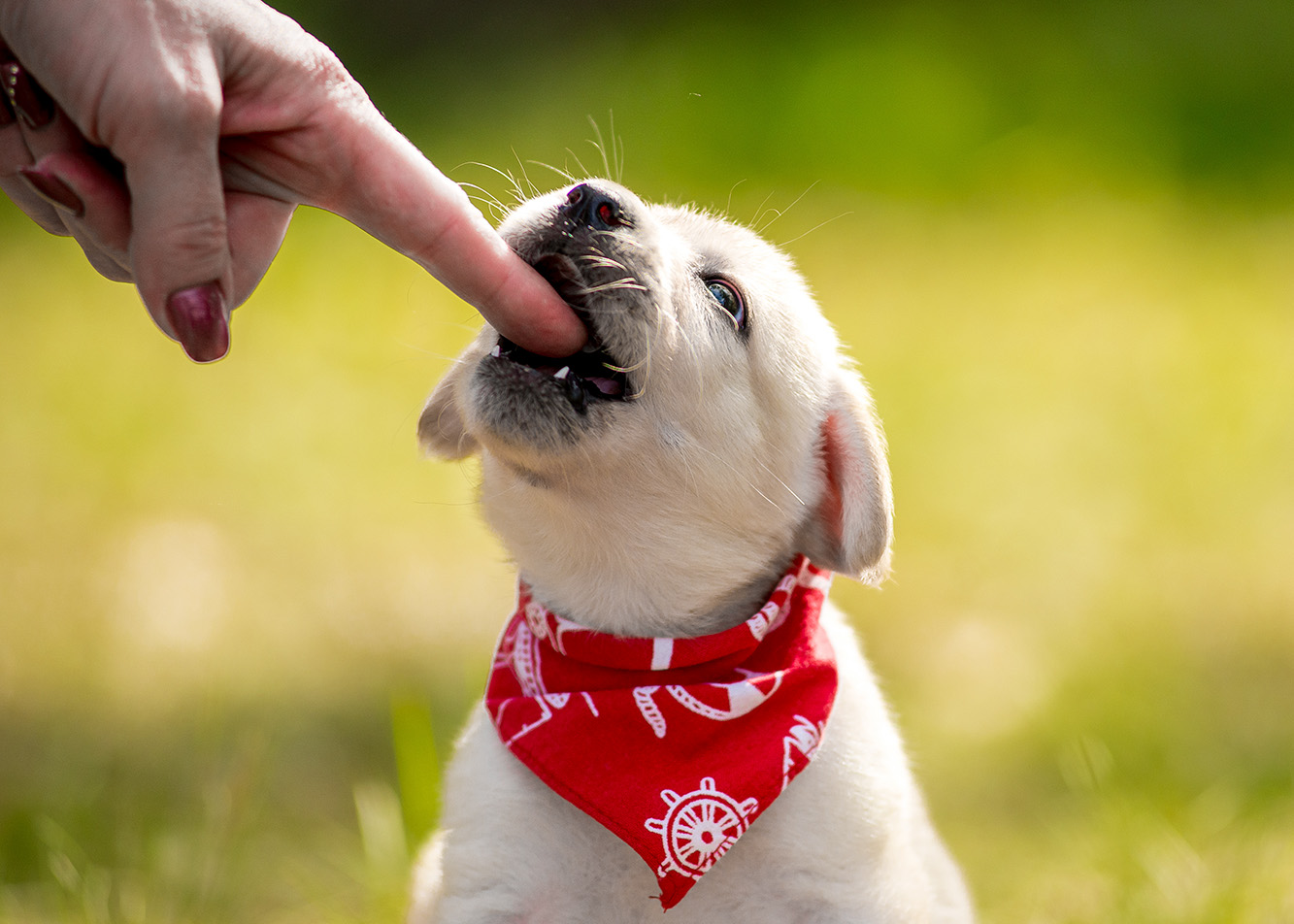
Why do puppies chew on hands??
Biting in puppies is often related to teething and the loss of baby teeth.That's when itchy gums become a problem, which can be very uncomfortable for your dog.Another reason is that young, playful puppies aren’t yet aware of how hard they can bite or that their bite might hurt someone.Given that a dog’s skin is more resistant to pain, it’s no surprise that a puppy hasn’t developed a sense of touch yet, and we should teach it that.It’s a good idea to consult with a trainer on this matter, as they will tailor the training approach to the cause of the biting.For example, if a dog nips because of a toothache, instead of squealing loudly and pulling your hand away, it’s better to remove it while saying the command “no”.If that doesn't help, we use the so-called "sense of loss" by leaving the room.With this method, it’s a good idea to give your dog something to chew on.
Another reason for nipping may be a desire for social interaction, such as playing together.In such situations, we often try to give the dog a toy in exchange for letting go of our hand.The difference is that the toy is boring and doesn't run away, but a hand that's been bitten does.This behavior can get the puppy overexcited, so it’s a good idea to learn, under the guidance of a professional, how to play with your dog properly so that the toy becomes just as appealing as your hand.The trainer will also demonstrate how to focus on playing with your dog rather than on competition, which, if done incorrectly, can lead to behavioral problems.
For this activity, it’s a good idea to use two identical or similar toys that are meant for pulling and tugging.You can use special long ropes so that the toy can run across the ground, simulating a chase after game.With these two toys, you can train your dog using a trade-off approach, which can help you teach the command "drop it and fetch" in the future.Another benefit of this kind of play is that we’re building our own value rather than that of the object, which helps us build a relationship with our dog.Let’s keep in mind, however, that this kind of play is stimulating, and in the wild, almost every chase ends in a meal.That’s why it’s a good idea to end the game by scattering your pet’s favorite food on the floor or on a snuffle mat so your pet can calm down and celebrate its victory :)
Communication is key: aggression between dogs and humans
Whether it’s a puppy, an adult dog, or a senior dog, and whether we’re talking about barking, growling, or nipping, it’s important to remember that this is canine communication!If we want to work through a problem, we first need to understand what it means.Only once we have a foundation can we build on it.Often, the problem arises from a lack of understanding of the differences in communication between dogs and humans.
When we try to show our dogs our human feelings or love, our gestures sometimes unintentionally scare them.So, what should you look out for, and what should you avoid doing??
- reach your hand over the dog's head, e.g., to pet it,
- lean over the dog and restrict its space,
- approach the dog from the front,
- look a dog straight in the eye
- and keep your head close to the dog's.
As you can see, it’s possible to unintentionally provoke a dog of any age into aggressive behavior.By learning about canine communication, we can avoid situations in which a dog resorts to aggression.
What if we have both a dog and a child under one roof??Keep in mind that small children are not suitable companions for a dog, due to their unpredictable and chaotic movements.Dogs like routine and predictability—the complete opposite of children.That’s why, when arranging the space in our home, we should design it so that our four-legged friend has a space all to themselves, where they can rest and unwind.In addition, we should supervise every interaction between a child and a dog and teach the child from an early age how to interact with a dog.If you have any doubts, it’s a good idea to consult a dog behaviorist to help you build a healthy relationship with your dog..
Another issue is aggression between dogs and adults.It doesn't matter whether we're talking about strangers or family members; we shouldn't downplay this issue.Let’s remember that most cases of aggression are anxiety-related, and identifying the cause will help us develop a treatment plan.After conducting a detailed interview, the behavioral therapist is able to identify details from the past that will help pinpoint the root of the problem.In the case of adopted dogs, whose history we don’t know, careful observation will allow us to develop a plan of action to resolve the issue.
Aggression toward another dog
Just as with humans, aggression toward other dogs often stems from fear.This is often the result of improper socialization in the case of puppies, or negative experiences in the case of adult dogs.
However, we often provoke aggressive behavior in our dogs ourselves, regardless of their age.When we see another dog in the distance, we—the owners—want our dogs to say hello and play.Is it a good idea to force our dog to interact with another dog when he doesn't want to??To answer this question, you need to understand canine communication, which is the key to understanding dog behavior.It is precisely these unfortunate misunderstandings that lead to aggression.That’s why, whether we’re talking about puppies or adult dogs, it’s a good idea to have a specialist come over to explain how to communicate with them.It’s worth learning this language because it will allow you to have a conversation with your dog rather than a one-sided conversation.
Aggression and Dog Health
Sometimes, for most of our dog’s life, we haven’t had any problems with aggressive behavior.However, as a dog gets older, these issues may arise; in such cases, in addition to scheduling an appointment with a dog behaviorist, we should visit a veterinarian.Sometimes medical conditions or illnesses are the cause of behavioral changes, and in such cases, behavioral therapy alone will not be effective unless the underlying health issue is addressed.
Aggression and Frustration
Every dog has behavioral needs, which vary slightly depending on their breed and type.Let’s remember that it’s possible to neglect a dog’s needs just as much as it is to overdo it.In such cases, frustration may arise, which manifests itself as aggression.That’s why it’s a good idea to work with a dog behaviorist to assess how well your dog’s needs are being met and to plan activities that are both appropriate and enjoyable for him.
Hunting aggression
Less common than anxiety attacks, but often confused with them.When displaying hunting behavior, a predator is trying to obtain food, but can the desire to obtain food be considered aggression??On the other hand, its definition clearly states that restricting freedom—and especially harming another organism—is aggressive behavior.In hunting behavior, the animal is driven by different emotions; often, the hunt itself is a source of pleasure for the dog. Therefore, when we talk about chasing other animals, such as hares or deer, we can consider this behavior to be hunting aggression.Nevertheless, fear-based aggression usually manifests itself toward people or other dogs.
Summary
There are many triggers for aggressive behavior, and using the wrong methods can make the situation worse; therefore, when dealing with such a serious problem, we should consult a behaviorist.Trying to find help on our own often ends up with a visit to a behaviorist anyway, and we subject our dog to unnecessary stress by trying to help him.It’s worth keeping this in mind because behaviorists focus on the cause of a given behavior rather than its effect.
Recommended