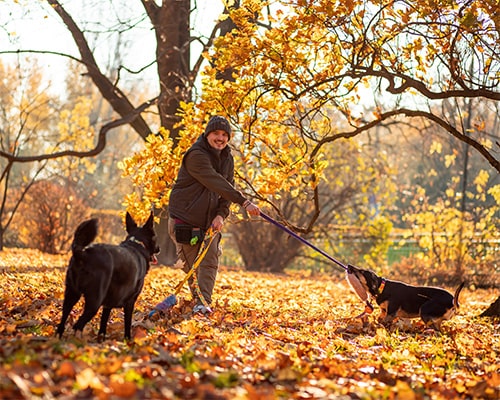
Living with a demanding dog


Living with a dog that is commonly described as "demanding" is best suited to working breeds, which require more involvement in daily life.This term is also commonly used among behaviorists and does not imply anything negative; rather, it refers to behaviors that are disruptive in everyday life (hyperactivity, destruction of objects, excessive barking), or even unacceptable (aggression); it is not easy.Our surroundings don't make things any easier—the noise, the hustle and bustle, the crowds, the tall buildings—and our emotions while walking don't help in this situation.Instead of bringing us joy, walks are stressful.Let’s think about how to handle a pet like this and what to look out for?
Give the dog a break!
There’s no denying that our emotions—such as stress, anger, and joy—affect our dog.If we're stressed during a walk, our dog will be more sensitive and its reactions will be more intense.
To help our dog, it is very important to find inner peace on our own.Sure, we can take three deep breaths before going for a walk, but that might not be enough.The most important thing is to accept that our dog is demanding.Accepting this will help us stabilize our emotions.And recognizing our pet’s positive traits will make it easier for us to work through any issues!
Our stress and negative attitude toward our dog, as well as comparing him to others, will make it harder for us to go through therapy, so the first step is: GIVE YOUR DOG A BREAK and …
TAKE A BREAK!
Our well-being and energy are truly very important.And life with a dog—not just one with special needs—can be very demanding.Taking care of ourselves has a huge impact on our well-being, and if we want to help our dog, we need to be well-rested and radiate inner peace.
Maintaining the space, and advice and comments from third parties
It is very important to maintain a proper distance and respect personal space.Overstimulating a dog can have the opposite effect.However, owners of anxious dogs are often advised to introduce their dog to every dog they meet or to put it in challenging situations so that it can get used to them.
In an effort to avoid an aggressive outburst, the dog owners try to walk away with their dog, but they can't because other dog owners keep following them.Passersby often stop to wait for the stressed, barking dog to calm down, reaching out to it or saying something.
Situations like these are the perfect opportunity to practice assertiveness and clearly set boundaries with strangers.Ensuring our pet's comfort is an important skill, but unfortunately, it can be very difficult in such situations.This is because it's hard to make a rational decision when you're under stress.
Yellow ribbon
A yellow ribbon or yellow accents on a leash or collar are details that should give passersby pause.This is a clear message that a dog with these markings needs space.It's not just for decoration.Unfortunately, a large portion of the public is unaware of this or ignores such signs and pressures dog owners.This is a situation that often affects our emotions and restricts our space, which, unfortunately, can have a significant impact on our progress in behavioral therapy.
So, if you see a dog with a yellow ribbon or any other yellow item on the horizon, or a dog owner trying to walk away, make it easier for them and get out of the way.
Advice from the Internet or a behaviorist
When seeking help, we need to be clear that every dog, every case, and every situation is different.By following advice from the internet, we can—but don’t have to—help our pet.It’s possible that we might make the situation worse.
Therefore, it is very important to consider whether it might be worth consulting a specialist in person or online, after preparing the recordings in advance.A behaviorist can tailor their techniques to a specific situation, which is important.
Summary
Owners of problem pets don't have it easy.They are rarely understood, and their dogs are often seen as ill-mannered and aggressive.
All of this makes them reluctant to go for walks, which ultimately makes the problem worse.If you want to help someone with a problem dog, it doesn’t take much—just step aside and let them go.These small gestures are huge steps in a dog’s therapy and can make a world of difference in its life.