
How can you keep your cat safe on New Year's Eve?
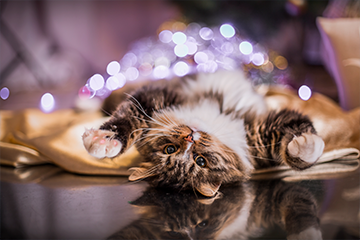

For us, New Year's Eve is a chance to have a great time.Unfortunately, cats don't usually share our excitement about the New Year, mainly because of the fireworks.The loud bangs of New Year's Eve fireworks can be unbearable for animals with such incredibly sensitive hearing as cats.It’s exhausting even for those who aren’t afraid of fireworks, let alone for those who panic at the sound of the explosions.
A cat's sense of hearing
In terms of hearing, cats are almost perfect creatures.Their sense of hearing is so acute that, to illustrate this, one could say that every single sound a human hears is perceived by a cat as ten distinct sounds that come together to form a whole.The range of sounds that cats can hear is also many times greater than that of humans; it includes the ultrasonic frequencies used by bats for communication!That is precisely why the cat knows exactly where the mouse is moving under the floor and can track it down with precision.
On top of all this comes the structure of the ear and its ability to turn toward the source of the sound.In cats, there are as many as 14 ear muscles that control how the animal moves its ears.
Their keen sense of hearing is due to the fact that cats, despite living under the same roof as humans, have not given up hunting.And since they are still small, efficient predators, their hearing has remained sharp.
Sounds at home
Probably every cat owner could name at least one sound that a cat simply can’t ignore.It could be the buzzing of a fly, the sound of a can of food being opened, or the refrigerator door being opened.Their keen senses prompt cats to react to the slightest sound so they don't miss a single opportunity.
The sounds to which cats are more sensitive are usually high-pitched and rustling—hence their stronger reaction to words containing "hissing" sounds.Many cats also dislike high-pitched voices or loud, shrill laughter, but they won’t pay any attention to a quiet conversation.
New Year's Eve – what to do?
On New Year's Eve, the biggest problem is firecrackers going off suddenly, which can cause severe anxiety in many animals—not just cats, but also dogs, birds, and rodents.So what can you do to help your pet get through this time??Here is a list of tips:
- DO NOT LET YOUR CAT OUT OF THE HOUSE! -This is something that should be practiced all year round, not just on New Year's Eve, but it's especially important on that night.
- Feed them earlier—give your cat dinner around 5:00–6:00 p.m., because they might not want to eat later due to stress.
- Set up a hiding spot—let your cat take refuge in a dark place as far away from windows as possible, such as inside a closet, in the bathroom, or under the bed; make sure it already has easy access to this spot.
- Before midnight, close the curtains and put on some soft music—you can even find special relaxation music for cats on YouTube to make your evening more enjoyable!
- Stay calm and collected—if you get upset, your cat will feel more stressed too.
- Don’t force your pet out of its hiding place—if the gunfire stops and your cat is still hiding, give it time to calm down and regain its composure.
- DO NOT ADMINISTER ANY SEDATIVES ON YOUR OWN! Any such action should be discussed with a veterinarian or animal behaviorist beforehand.
There’s no perfect way to do it, but with a little effort, we can help our pet get through this special night.We hope that these tips will help you all ring in the New Year calmly and without unnecessary stress—which is what we wholeheartedly wish for you!
CAT BEHAVIOR EXPERT
Małgorzata Biegańska-Hendryk