
A cat's tail—what does it tell us?
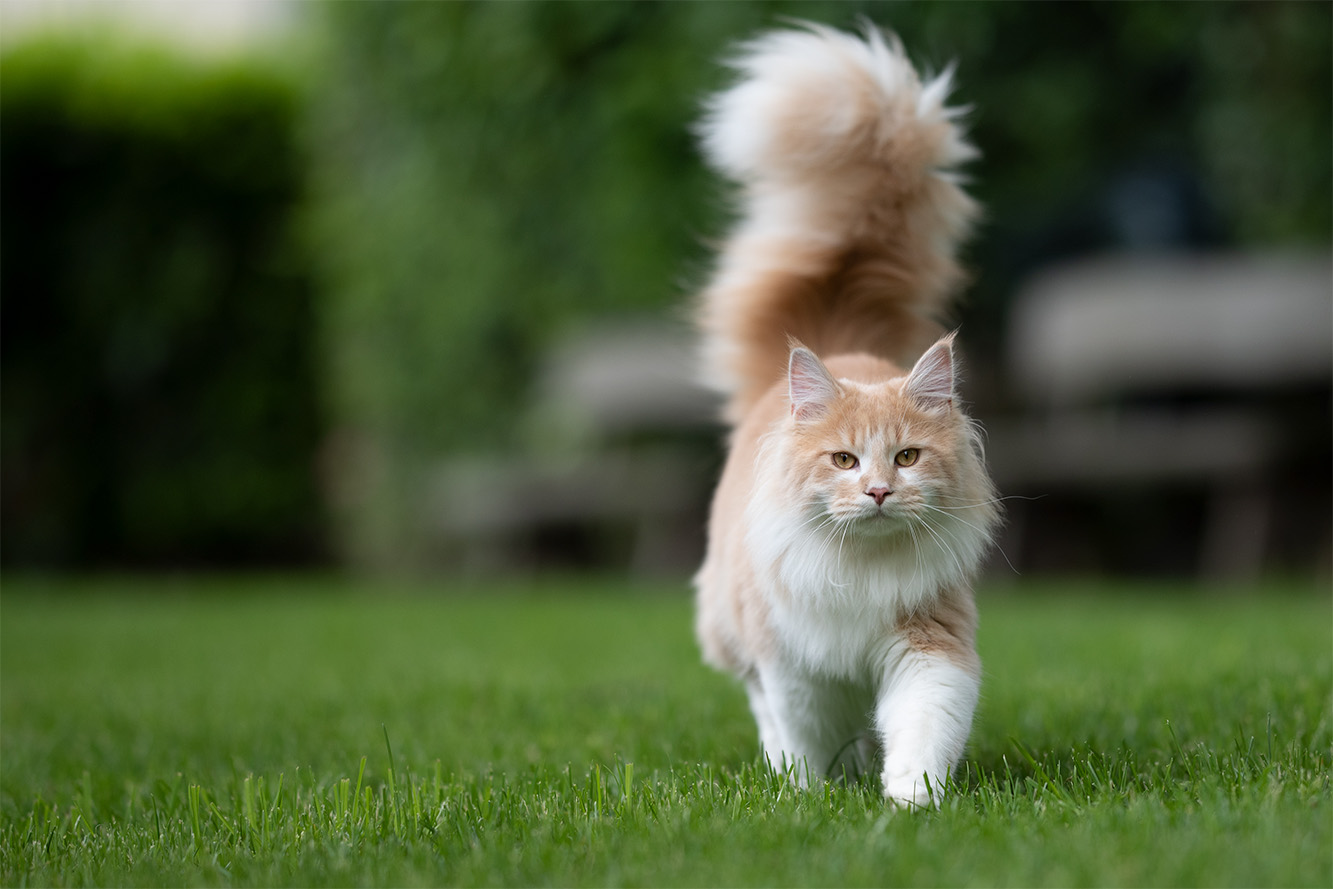

One of the popular sayings about cats is the one about wagging their tails: a cat that wags its tail is said to be angry, and it’s best not to provoke it.Is that really the case??Not quite.It turns out that the world of feline communication is much more complex and requires us to pay close attention—and not just when it comes to the tail.
How cats communicate
In the world of cats, we can observe various ways of communicating that they use depending on the situation and what they want to convey.The main classification distinguishes three groups of messages:
- audio,
- scented,
- visual.
When discussing a cat’s tail, we must focus primarily on the last category, since the signals sent using the tail are precisely the kind of messages that are perceived visually.Of course, these can be combined with other forms of communication (for example, a cat with a puffed-up tail may hiss, while a cat shaking its tail held upright may be marking its territory with urine at the same time).The most important thing, however, is to remember that a cat is a whole being, and when interpreting its signals, we must not focus solely on its tail!
How to "read" a cat?What a cat's tail tells us?
Before we start paying attention to the tail’s movements or position, it’s a good idea to take in the whole animal: its posture, any tension or relaxation in its body, the expression in its eyes, the position of its ears and whiskers, and the condition of its coat.Let’s also pay attention to gestures such as licking one’s nose or looking away, or, conversely, staring intently at an object or a point, and a willingness or reluctance to make eye contact or physical contact.The entire situational context surrounding a cat's behavior is important.Once we've analyzed all of that, we can also take a closer look at the tail.For if we focus only on him, the result will be like trying to watch a movie through a keyhole—we’ll certainly see something, but the picture won’t be complete.
Signals sent with the tail
Cats typically use their tails to send a message from a distance or to convey their current emotions.Here are a few interesting examples:
- a tail held high or slightly curved at the tip in a "question mark" shape—this is how confident, content animals, or those that want to say hello, usually carry their tails.This is a very interesting signal, transferred from intraspecies communication to interaction with humans.In the wild, kittens arch their tails when they hear their mother calling, which helps the mother locate them more easily in tall grass or thickets.As a result of the domestication process, cats have applied this behavior to their interactions with us, which may suggest that they view us somewhat as parents;
- A tail pressed against the body or tucked under the belly is often a sign of fear, anxiety, or insecurity.This may also be accompanied by a crouching posture and general hunching, as the animal wants to appear as small as possible (following the principle that “since I’m small, I’m not worth paying attention to because I’m not a threat to anyone”).This kind of signal usually means that the animal needs help because it feels uncomfortable in that situation;
- A cat sitting with its tail wrapped around the wrists of its front paws—this is a posture that says, “I’m watching, but I don’t want to be touched, so keep your distance.”.This isn't exactly a warning, but it's a clear sign that the pet doesn't want to be touched;
- rubbing one's tail against a person or another animal is a very friendly gesture that expresses a desire for closeness and deep trust.In the wild, cats don't pet each other, but they may wrap their tails around each other, for example, when walking together in the same direction.It is a sign of great familiarity and should always be appreciated;
- Bristled fur on the tail or a tail curved into an inverted U—this is often a sign of nervousness or anxiety caused by the pet being startled by something (e.g., a loud noise).Piloerection—the bristling of fur on the tail, back, or entire body—is intended to make the animal appear larger, thereby signaling that it is not an easy opponent and is best left alone.It also happens that cats, especially young ones, puff out their tails when playing.If this happens, it’s usually a sign that the animal is brimming with emotion, though it’s usually more about excitement than fear,
- A gentle "tap" with the tip of the tail is a sign of irritation and an indication that our cat is running out of patience.Therefore, if this behavior occurs while we are petting our pet, we should stop immediately;
- Vigorous tail-wagging to the point of "thumping the sides"—this is usually a sign of frustration or intense agitation.This message should be interpreted as: “I’ve had enough—leave immediately.”!".Sometimes we also see such reactions when a cat is unable to satisfy a certain need (e.g., to catch a bird sitting outside the window).In such cases, it’s a good idea to redirect their attention to another object or activity to relieve the tension;
- tail held halfway down, hanging loosely behind the cat as it moves – indicates a general sense of ease and relaxation.A tail like that tells us nothing more than that the pet is feeling fine and nothing is bothering it.
Of course, there are more messages sent using the tail, but these seem to be the most important ones.That’s not all worth noting when discussing this remarkable part of a cat’s body.
What else is worth knowing?
In cats, the tail is responsible for maintaining balance—it helps keep the body steady, which is very helpful when running, making sudden turns, and jumping, especially over longer distances.Therefore, any injury to the tail can cause the cat to have trouble maintaining its balance, making certain areas of the house inaccessible to it.
Unfortunately, a cat's tail is quite prone to injury, so you should never pull on a cat's tail or drag it out by its tail, for example, from a hiding place.If a cat falls onto the base of its tail, it may fracture the tail or damage the vertebrae; therefore, a follow-up X-ray should always be taken to check for serious injury.
With long-haired and semi-long-haired cats, you shouldn’t overdo it when grooming their tails, since the hair there grows the slowest.Therefore, it is recommended to comb it much less frequently than the rest of the hair to prevent hair loss.
